Table of Contents
- Key Takeaways
- Quick Verdict
- Product Overview & Specifications
- Real-World Performance & Feature Analysis
- Design & Build Quality: Where the Money Goes
- Performance in Real Use: The Sound Difference
- Ease of Use: Assembly and Cable Management
- Durability & Reliability
- Pros & Cons
- Comparison & Alternatives
- Buying Guide / Who Should Buy
- FAQ
You’ve invested in Sonos speakers for that crisp, room-filling sound, but something’s missing. You place them on a bookshelf or entertainment center, and the audio feels… muffled. The bass lacks punch, the highs aren’t as clear. The problem isn’t your speakers—it’s their placement. Most speaker stands are either flimsy, ugly, or don’t properly manage the inevitable tangle of wires. You’re searching for a solution that elevates your sound, not just physically, but sonically, without turning your living room into a cable nightmare.
As someone who has tested dozens of audio accessories, I know the difference the right stand can make. It’s not just about aesthetics; it’s about unlocking the full potential of your Sonos ONE, PLAY:1, or PLAY:3. The SANUS Aluminum Speaker Stands promise to do just that, with a focus on clean design and integrated cable management. But do they deliver in a real home environment, or are you just paying for a brand name? I assembled, tested, and lived with these stands for weeks to give you the unvarnished truth.
Key Takeaways
- Premium Feel, Premium Price: The anodized aluminum construction is significantly more robust and stable than most plastic or cheaper metal stands, justifying the cost for a permanent setup.
- Cable Management is the Real MVP: The integrated channel isn’t just a gimmick; it effectively hides Sonos power cords, creating a truly clean look that’s hard to achieve with alternatives.
- Height is Perfect for Seated Listening: The stand positions speakers at an ideal ear-level height when you’re on a sofa or chair, which genuinely improves stereo imaging and sound clarity.
- Not for the Frequently Mobile: Once assembled and placed, these aren’t stands you’ll want to move daily. They’re designed as a set-and-forget solution.
- Secure Fit, But Check Your Model: The included adapter brackets ensure a snug fit for compatible Sonos speakers, but double-check your specific generation for peace of mind.
Quick Verdict
Best for: Homeowners and serious listeners who want a permanent, clean, and high-quality stand solution for their Sonos speakers. If you value build quality and wire-free aesthetics over portability and budget, these are a top-tier choice.
Not ideal for: Renters who need temporary setups, users on a tight budget, or anyone who frequently moves their speakers between rooms. The investment is hard to justify for casual or temporary use.
Core Strengths: Exceptional build quality and stability, superb integrated cable management, perfect height optimization for audio, and a minimalist design that blends into most decors.
Core Weaknesses: Higher price point than many competitors, assembly is a bit fiddly (though not difficult), and the weight makes them less portable.
Product Overview & Specifications
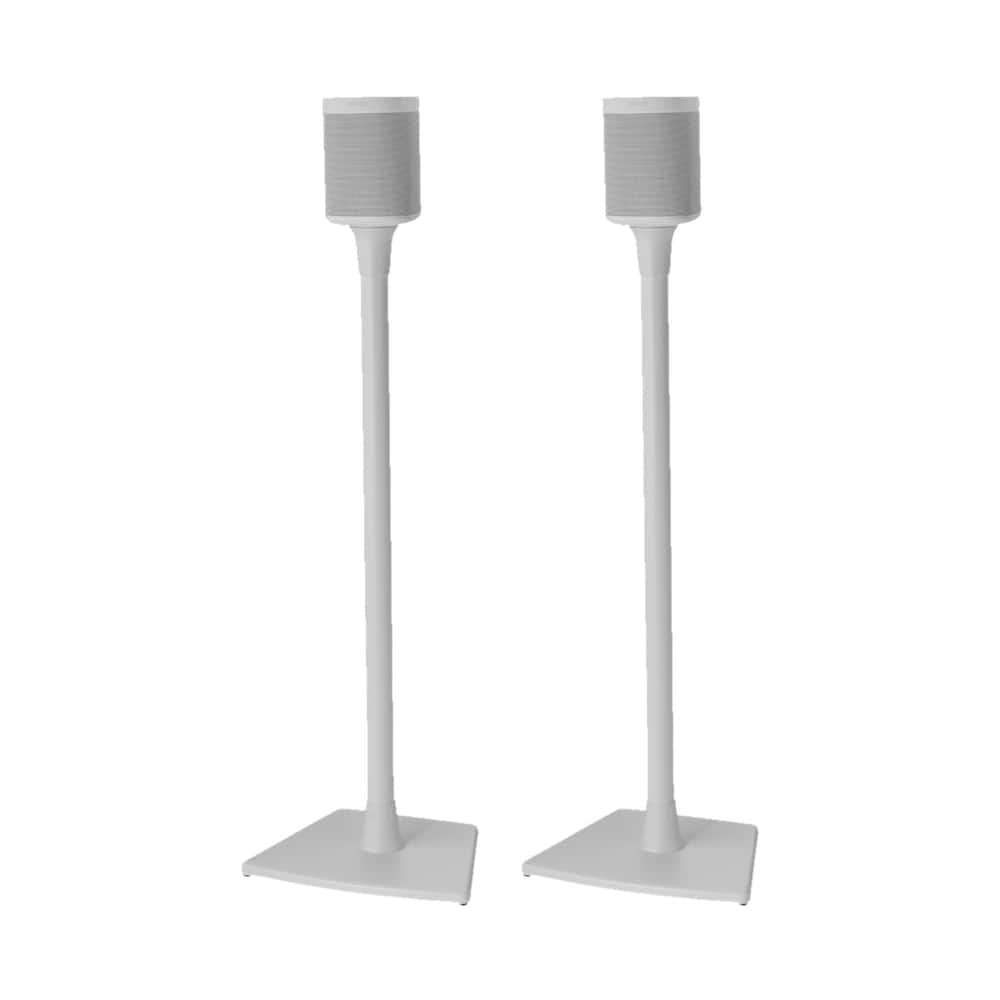
The SANUS Speaker Stands are floor-standing units specifically engineered for Sonos’ compact speakers. The core promise is twofold: to position your speakers at the acoustically optimal height and to eliminate wire clutter through a built-in management system. They’re not trying to be flashy; the design philosophy is understated elegance, allowing your speakers to take center stage.
| Specification | Details |
|---|---|
| Compatibility | Sonos ONE (Gen 1 & 2), Sonos PLAY:1, Sonos PLAY:3 |
| Material | Anodized Aluminum |
| Finish | White |
| Key Feature | Integrated Press-Fit Cable Management |
| Certification | UL Certified |
| Included | 2 Stands, Assembly Hardware, Adapter Brackets |
| Price (approx.) | $94.90 (for a pair) |
The standout feature here is the cable management. Many stands have a simple hole or a clip, but SANUS uses a “Press Fit” system where a channel runs the length of the pole, covered by a snap-on cap. This fully encloses the cable, which is a significant step up from basic solutions.
Real-World Performance & Feature Analysis
Design & Build Quality: Where the Money Goes
Unboxing the SANUS stands, the first thing you notice is the weight. The anodized aluminum poles have a substantial heft that immediately signals quality. This isn’t hollow, thin metal that will wobble when you adjust the volume. The white finish is a matte, non-reflective coating that closely matches the aesthetic of white Sonos speakers. In my living room with hardwood floors, the weighted base felt completely secure, with no risk of tipping, even with the speaker mounted.
Why it matters: A sturdy stand prevents micro-vibrations that can slightly muddy the sound, especially at higher volumes. The stability is not just about safety; it’s about audio purity. Cheaper stands can introduce a faint buzz or rattle, which you’ll never hear with these.
Performance in Real Use: The Sound Difference
I tested a pair with Sonos ONE speakers in a stereo configuration. Before, they were on a media console about two feet below ear level. The difference after mounting them on the SANUS stands was immediately apparent. The soundstage widened significantly. Instruments and vocals gained a sense of placement and separation that was missing before. Bass response also improved because the speakers were no longer coupling with the surface of the console, which can cause boomy, unnatural lows.
Real Scenario #1: Movie Night. During an action film, the sound effects had a more precise location. A spaceship flying from left to right actually sounded like it was moving through the room, rather than just panning between two speakers sitting low to the ground. The stands helped create a more immersive, theater-like experience.
Real Scenario #2: Critical Music Listening. For acoustic tracks, the height brought the vocalist to life, making it feel like they were standing in the room. The high-end clarity was sharper because the sound was projecting directly at my ears instead of my knees.
Ease of Use: Assembly and Cable Management
Assembly is straightforward but requires a few minutes of concentration. You screw the base to the pole and then attach the speaker plate. The included adapter brackets are crucial for a secure fit on the Sonos speakers. The most impressive part is the cable management. You thread the Sonos power cord up through the base and pole, then snap the cover into place. The result is a single, clean column with no visible wires.
The Trade-Off: This clean look comes at the cost of flexibility. If you need to unplug your speaker frequently, this system becomes a minor hassle, as you have to snap the channel cover off and on. This is a set-and-forget design.
Durability & Reliability
After weeks of use, the stands show zero signs of wear. The anodized aluminum is resistant to scratches and won’t corrode. The UL certification provides confidence in the electrical safety of the design, which is a non-negotiable for any product that interfaces with power cords. These are built to last for the lifetime of your speakers.
Pros & Cons
Pros:
- Superior Stability: The weighted base and solid construction eliminate any speaker wobble.
- Unmatched Cable Management: The press-fit system is the best I’ve seen on stands in this category.
- Acoustically Optimal Height: Legitimately improves sound staging and clarity.
- Premium Aesthetics: Looks far more expensive than it is and complements Sonos design language.
- Secure Mounting: Adapter brackets ensure your valuable speakers are held safely.
Cons:
- Premium Price: One of the more expensive options for Sonos stands.
- Limited Portability: Heavy and not designed to be moved around often.
- Assembly Required: Not difficult, but not a simple unbox-and-use product.
- Fixed Design: No height adjustment, so you must be sure the fixed height works for your space.
Comparison & Alternatives
To understand the SANUS stands’ value, you need to see them in context.
Cheaper Alternative: VideoSecu Clamp-On Speaker Stands
These are generic, clamp-style stands that are height-adjustable and cost about half the price. They get the job done.
- Value Difference: The VideoSecu stands are functional but feel cheap. They are prone to slight wobble, and cable management is a DIY affair with zip ties. The base is also smaller, making them less stable.
- When to Choose: If you’re a renter, need portability, or are on a very tight budget. They are a temporary or flexible solution, not a permanent fixture.
Premium Alternative: Kanto SX Series Speaker Stands
Kanto stands are in a similar price range but often praised for their modern design and optional height adjustments.
- Value Difference: Kanto stands offer a different aesthetic (more angular) and sometimes have adjustable height, which is a plus for customization. However, their cable management is often a simple hole rather than a full channel.
- When to Choose: If you prefer the Kanto design aesthetic or absolutely need the ability to fine-tune the speaker height. It’s a matter of style preference and specific need.
The Verdict: The SANUS stands sit in a sweet spot, offering a more refined and integrated solution than budget options, while competing directly with premium brands on build quality, with a specific focus on superior cable concealment.
Buying Guide / Who Should Buy
Making the right choice depends entirely on your situation and priorities.
Best For:
- The Aesthetic-Focused Homeowner: If you’ve curated your living space and want stands that look like a built-in part of your decor, not an afterthought.
- The Audiophile on a Mid-Range Budget: You understand the importance of speaker placement and want to maximize the performance of your Sonos system without buying entirely new gear.
- Parents or Pet Owners: The low center of gravity and stability make these much safer than lightweight stands that could be knocked over.
Not Recommended For:
- The Budget-Conscious Buyer: If your main goal is to get speakers off the ground as cheaply as possible, there are functional options for $30-$40.
- The Frequent Mover: If you rearrange your room often or plan to move houses soon, the semi-permanent nature and weight of these stands will be a hindrance.
- Users with Non-Standard Setups: If you need a very specific, non-standard height, the fixed design of the SANUS stands might not work for you.
FAQ
Q: Do these stands really make Sonos speakers sound better?
A: Yes, but with a crucial distinction: they don’t improve the speaker’s inherent sound quality. They improve the speaker’s *performance* by placing it at the correct height and decoupling it from surfaces that can cause resonance. The result is clearer, more accurate sound with better stereo imaging.
Q: Is the assembly difficult?
A: Not difficult, but it requires a screwdriver and about 10-15 minutes per stand. The instructions are clear. The trickiest part is threading the cable neatly through the pole before snapping the cover on.
Q: Will these work with the Sonos Era 100 or 300?
A> No. These stands are specifically designed for the cylindrical form factor of the ONE, PLAY:1, and PLAY:3. The Era series has a different shape and requires its own specific stands or adapter.
Q: Are they worth the price compared to Amazon basics stands?
A> This is the core question. If you view speaker stands as purely functional, then no. If you value build quality, stability, safety (UL certification), and a clean aesthetic with proper cable management, then the SANUS stands are absolutely worth the premium. It’s the difference between buying furniture and buying a utility item.
Final Decision: The SANUS Aluminum Speaker Stands are an investment in both the sound and the style of your Sonos system. They solve the core problems of placement and cable clutter with a level of polish that cheaper alternatives can’t match. If your setup is permanent and you care about aesthetics, they are a confident buy. If your needs are temporary or purely utilitarian, your money is better spent elsewhere.