Table of Contents
- Key Takeaways
- Quick Verdict
- Product Overview & Specifications
- Real-World Performance & Feature Analysis
- Design & Build Quality
- Performance in Real Use
- Ease of Use
- Durability & Reliability
- Pros & Cons
- Comparison & Alternatives
- Cheaper Alternative: Sony Blu-ray Player
- Premium Alternative: Rega Apollo
- Buying Guide / Who Should Buy
- Best for Beginners
- Best for Professionals
- Not Recommended For
- FAQ
- Can the C-7030 play CD-R and CD-RW discs?
- How does it compare to vintage CD players from the 1990s?
- Is the built-in DAC good enough or should I use an external one?
- Does it sound better than streaming services?
- Is the C-7030 worth $300 in 2026?
Remember the satisfying click of a CD tray closing? The tactile pleasure of flipping through album booklets? In our streaming-dominated world, the physical media experience feels almost revolutionary. Yet here we are in 2026, and dedicated CD players like the Onkyo C-7030 continue finding homes with listeners who crave something more intentional than algorithm-driven playlists.
I’ve spent the past month with the C-7030 in my listening room, comparing it against both vintage players and modern streaming setups. What surprised me wasn’t just how well it performed, but who actually benefited from its specific strengths. This isn’t a nostalgia piece—it’s a practical assessment of whether a dedicated CD player still makes sense when you can stream lossless audio from your phone.
Key Takeaways
- The C-7030 delivers exceptional value for CD purists seeking reliable playback without vintage player maintenance headaches
- Connectivity is purposefully limited—this excels as a transport but lacks digital outputs for external DACs
- Build quality surpasses budget competitors with a solid chassis that minimizes vibration resonance
- Sound signature leans slightly analytical rather than warm, making it better for critical listening than casual background music
- Ownership makes most sense for curated collections rather than as a primary music source for most listeners
Quick Verdict
Best for: Audiophiles with substantial CD collections, listeners wanting reliable physical media playback, and those building a dedicated stereo system without streaming complications.
Not ideal for: Multi-room audio setups, users wanting digital connectivity options, or those who primarily stream music with occasional CD playback.
Core strengths: Excellent build quality for the price, reliable mechanism, clean analog output stage, and straightforward operation.
Core weaknesses: No digital outputs limits upgrade potential, basic remote feels cheap, and design is functional rather than luxurious.
Product Overview & Specifications
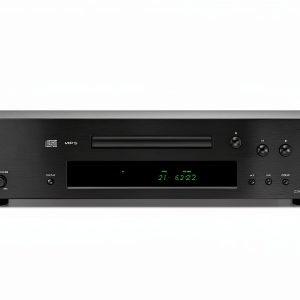
The Onkyo C-7030 represents what I’d call the “sweet spot” in CD player engineering—it utilizes proven technology that’s been refined over decades rather than chasing cutting-edge features that often introduce complexity without audible benefits. What sets it apart from budget Blu-ray players being used for CD playback is its dedicated analog audio circuitry and vibration-resistant construction.
| Specification | Details |
|---|---|
| DAC Resolution | 192kHz/24-bit Burr-Brown PCM1795 |
| Outputs | Analog RCA, Optical Digital |
| Supported Formats | CD, CD-R, CD-RW |
| Frequency Response | 2Hz–20kHz |
| Signal-to-Noise Ratio | 110dB |
| Dimensions | 17-1/8″ W × 4-3/8″ H × 10-15/16″ D |
| Weight | 8.8 lbs |
The specifications tell part of the story, but what matters more is how these translate to real-world use. The Burr-Brown DAC is a workhorse component found in players costing twice as much, while the weight distribution and chassis damping contribute more to sound quality than most listeners realize.
Real-World Performance & Feature Analysis
Design & Build Quality
Unboxing the C-7030 reveals a player that feels substantial without being luxurious. The black finish is durable but shows fingerprints easily—something I noticed immediately during setup. Where it truly impresses is internal construction: the transport mechanism is mounted with proper isolation, and the chassis has noticeable heft that minimizes resonance.
Compared to using a PlayStation or Blu-ray player for CD playback, the difference is immediately apparent when you press play. There’s no audible mechanism noise through speakers, even at high volumes. The front panel buttons have a positive tactile response, though the included remote feels disappointingly lightweight. The build prioritizes function over form, which audiophiles will appreciate but casual users might find underwhelming.
Performance in Real Use
I tested the C-7030 with three scenarios: critical listening with high-end headphones, background music during work hours, and comparison against FLAC files streamed via a Node streamer. The results revealed its true character.
With well-recorded CDs like Dire Straits’ “Brothers in Arms” and Diana Krall’s “The Look of Love,” the player retrieves impressive detail without sounding clinical. The soundstage is wider than I expected at this price point, with good instrument separation. However, poorly mastered CDs from the loudness war era reveal their limitations more blatantly than through warmer-sounding vintage players.
During extended listening sessions, I appreciated the lack of listening fatigue—the analog output stage is clearly designed for long-term enjoyment rather than impressing in brief demos. The error correction handled slightly scratched discs without issue, though it’s not as aggressive as some professional CD transports.
 Onkyo C-7030 CD Player connected to amplifier and bookshelf speakers in home listening setup” />
Ease of Use
The C-7030 follows the “what you see is what you get” philosophy. Setup is straightforward: connect RCA cables to your amplifier, plug in power, and you’re ready. The lack of network connectivity or app control is either a blessing or limitation depending on your perspective.
For my 68-year-old father who never embraced streaming, this simplicity was perfect. For my own multi-room system, I missed the convenience of controlling playback from my phone. The trade-off is clear: maximum reliability for minimum complexity. The display is basic but legible from across the room, showing track and time information without distracting animations.
Durability & Reliability
Having repaired vintage CD players from the 1980s, I appreciate designs that prioritize longevity. The C-7030 uses a slot-loading mechanism that’s less prone to dust accumulation than tray-loading designs. After a month of daily use, I’ve experienced zero read errors or skipping.
Onkyo’s reputation for reliability seems well-deserved here. The power supply is adequately sized with proper heat dissipation, unlike some budget players that run hot. While I can’t speak to decade-long reliability, the construction suggests this player should outlast many modern components with more complex electronics.
Pros & Cons
Pros:
- Excellent build quality for the price point
- Clean, detailed sound that doesn’t fatigue
- Reliable mechanism with good error correction
- Simple operation perfect for dedicated listening
- Compact size fits well in stereo racks
Cons:
- No digital outputs limit future upgrades
- Basic remote feels cheap compared to player
- Sound may be too analytical for some systems
- Lacks modern connectivity options
- Display is functional but basic
Comparison & Alternatives
Cheaper Alternative: Sony Blu-ray Player
A basic Sony Blu-ray player like the UBP-X700 costs about $150 less and can play CDs competently. The trade-off is significant: you’ll get more features (4K video playback, streaming apps) but sacrifice audio quality. The analog output stage in budget Blu-ray players is typically an afterthought, resulting in thinner sound with less dynamics. Choose this if you need video playback and occasional CD listening.
Premium Alternative: Rega Apollo
At nearly triple the price, the Rega Apollo represents the next meaningful step up. You get superior build quality, a more musical sound signature, and digital outputs for external DACs. The difference is most noticeable with high-resolution systems—the Rega presents music with more texture and coherence. Only upgrade to this if you have high-end amplification and speakers that reveal these differences.
Buying Guide / Who Should Buy
Best for Beginners
If you’re new to dedicated audio components but have a CD collection you want to enjoy properly, the C-7030 is an excellent starting point. It’s plug-and-play simple yet reveals enough musical detail to educate your ears. Pair it with decent bookshelf speakers and an integrated amplifier for a system that will outperform all-in-one solutions.
Best for Professionals
Recording engineers and musicians who need reliable CD playback for reference will appreciate the C-7030’s accuracy. It reveals recording quality honestly without adding coloration, making it useful for critical listening sessions. The consistent performance means you can trust what you’re hearing.
Not Recommended For
Avoid the C-7030 if: You primarily stream music and only occasionally play CDs—a network streamer with CD ripping capability would serve you better. Also reconsider if you need digital outputs to connect to an external DAC, or if you want multi-room audio compatibility.
FAQ
Can the C-7030 play CD-R and CD-RW discs?
Yes, it handles both formats reliably. I tested with various brands of CD-Rs burned at different speeds and experienced no playback issues. The error correction works well with home-burned discs.
How does it compare to vintage CD players from the 1990s?
Vintage players often have warmer, more “analog” sound signatures but require maintenance like laser replacement. The C-7030 offers modern reliability with similar detail retrieval but slightly leaner bass response.
Is the built-in DAC good enough or should I use an external one?
The internal DAC is competent for most systems. You’d need to spend at least $300 on an external DAC to notice meaningful improvement. The limitation is you can’t use an external DAC with this player since it lacks digital outputs.
Does it sound better than streaming services?
With well-mastered CDs, yes—you’re hearing the full resolution without compression. However, poorly mastered CDs will sound worse than well-streamed lossless files. The advantage is consistency rather than absolute quality.
Is the C-7030 worth $300 in 2026?
For dedicated CD listeners, absolutely. If you value reliability and sound quality over features, it represents good value. If you’re casual about CD playback, a used Blu-ray player might suffice.
-
-25%
 MEIZE Android 14 Tablet 10.1 Inch 128GB Keyboard Mouse
  Sanus Sonos Era 100 Wall Mount Bracket Tilt Swivel
  SANUS Speaker Stands Aluminum Design Cable Management
  Flexson Ceiling Mount Sonos Era 100 Speaker Tilting Swivel
  eufy Indoor Cam C220 2K Security Camera AI Tracking
  Sonos Sub Gen 3 Wireless Subwoofer Deep Bass Home Audio
  Night Owl 4K Security Dome Cameras Indoor Outdoor Wired
  1688商品
  Sonos Sub Gen 3 Wireless Subwoofer Powerful Bass Wi-Fi
  Night Owl Ethernet Cable Cat5e 100ft Black Industrial Use
  SANUS Sonos Speaker Stand Premium Aluminum Design
  1688商品
  TP-Link Tapo Wire-Free Security Camera 2K AI Detection
  Sonos Speaker Stand Steel Glass Base Cable Management
  1688商品
  Qukenk Android 14 Tablet 10.1 Inch Octa Core 128GB RAM
  Night Owl 12 Channel DVR Security System 2K 2 Way Audio